
Madison County Court Records After a Jail Arrest
An arrest in Madison County does not by itself create a court case. After booking, the Madison County State's Attorney reviews the police work and decides what, if anything, to charge. When the prosecutor files a charging document, a case opens in the Third Judicial Circuit and the court record begins. From that point the record tracks the formal charges, the court dates, and the result. The arrest charge and the charge the prosecutor files are not always the same, which is why the court record is the document that matters.
The booking side and the court side answer different questions. For custody, charges read by phone, and booking detail, see the jail inmate records page, and for booking photos see the jail roster mugshots page. This page stays on the court record itself, the charges a prosecutor filed and how to follow them after an arrest. The screenshot below shows the Madison County State's Attorney homepage, the office that decides those charges.

How to Find Madison County Court Records After an Arrest
The court record lives with the Circuit Clerk, not the jail. The clerk's court records search page links a vendor portal where you can pull a case by a participant name or a case number. The clerk warns the search can load slowly during heavy use, and lists an 800-250-9884 support line for portal problems. Arrest and booking detail stays on the jail side; the court portal shows the filed charges and their status.
The screenshot below shows the official Circuit Clerk court records search page and its vendor link.
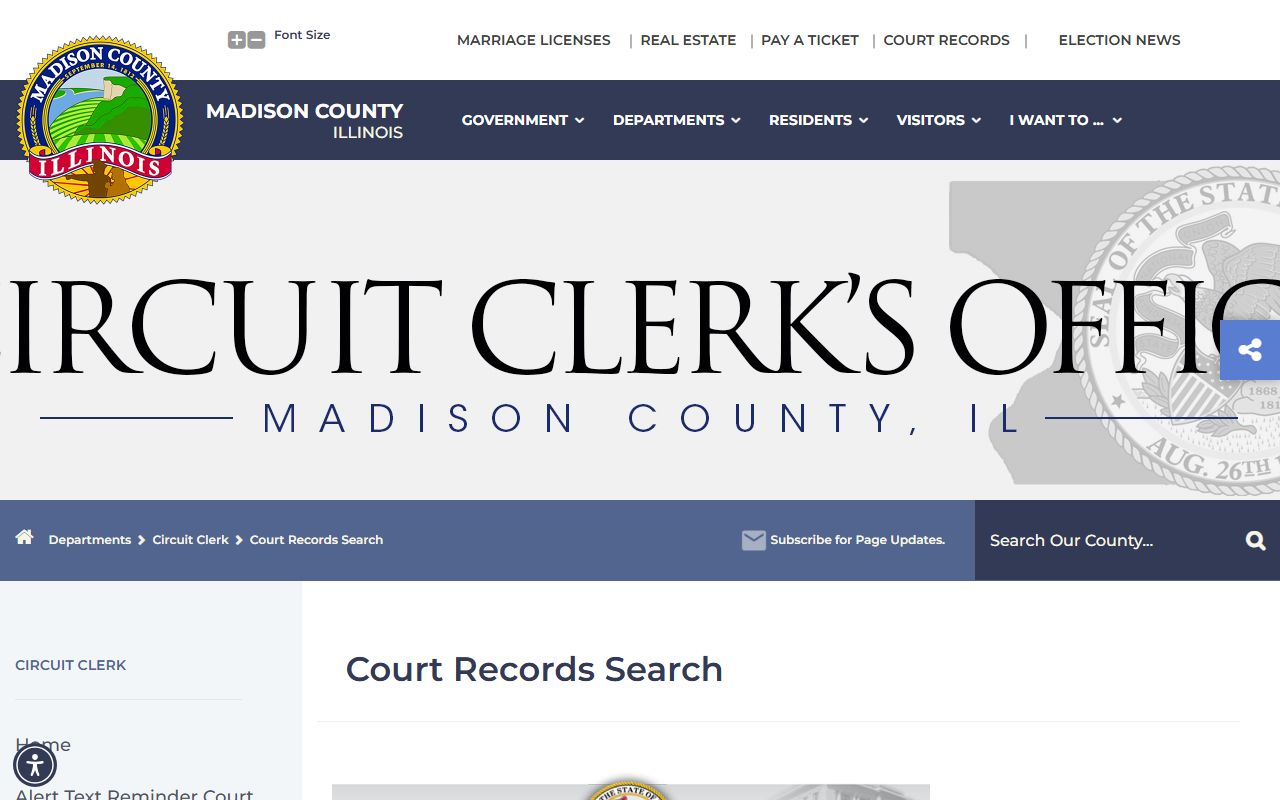
- Open the Circuit Clerk court records search and follow the link to the vendor portal.
- Search by the defendant's participant name or, if you have it, the exact case number.
- Open the case and read the list of filed charges.
- Check each charge's level and current status, and note the next court date.
For a record the portal does not show, the clerk's Archives department handles older court-copy requests, and statewide criminal-history lookups run through separate state channels rather than the county portal.
How Madison County Charges Get Filed After an Arrest
Walk the path from the arrest forward. Booking happens at the jail, then the court record begins the moment the prosecutor files a charging document. Illinois uses three main types. A complaint is the early sworn allegation. An information is the prosecutor's formal charge. An indictment is a charge returned by a grand jury, used for serious felonies. Each one can start the case, and the sheriff serves any warrant a court issues at the State's Attorney's request.
| Complaint | Information | Indictment | |
|---|---|---|---|
| Filed By | Officer / Prosecutor | Prosecutor | Grand Jury |
| Common For | Early or misdemeanor stage | Many felonies | Serious felonies |
| Starts | The case | The case | The case |
Charge Status in a Madison County Case
Charges change as a case moves. A prosecutor can amend a count, reduce it, add one, or drop it. That is why a booking charge on the jail side can differ from the charge the court record finally carries. Reading the status keeps you from drawing the wrong conclusion from an early entry. The terms below show up often in Illinois case records.
| Status | What It Means |
|---|---|
| Pending | The charge is filed and the case is still active, with no final outcome yet. |
| Amended / Reduced | The prosecutor changed the charge, often to a different or lesser count. |
| Dismissed | The charge was dropped and ended without a conviction on that count. |
| Nolle Prosequi | The prosecutor formally chose not to pursue the charge at this time. |
Bond and Release After a Madison County Arrest
Illinois no longer runs like a cash-bail state. Under Article 110 of the Code of Criminal Procedure, pretrial release is the default, and a court can deny release only for eligible charges and only after a detention hearing. So a person arrested in Madison County is usually released with conditions rather than by paying a set dollar amount. To check status, call the jail line at 618-692-1064 and confirm whether the case is under release conditions, court-ordered detention, or a hold from another agency. Do not assume a cash payment alone will release someone.
| Outcome | How It Works |
|---|---|
| Pretrial release | The default; the court sets conditions when needed to ensure appearance and safety. |
| Detention | Release denied only for eligible charges after a hearing under 725 ILCS 5/110-6.1. |
| Warrant or agency hold | Another warrant or a state, federal, or immigration hold can keep a person in custody. |
| Conditions of release | Non-monetary terms the person must follow while the case is open. |
Warrants That Lead to a Madison County Arrest
Many bookings start with a warrant. A judge issues an arrest or bench warrant, the sheriff or a local police agency serves it, and the person is booked. Madison County does not publish an online active-warrant search, so the practical checks are the court portal, where bench warrants tied to a filed case can appear, and a call to the sheriff. The county's 2024 report listed 1,918 warrants on file at year end, a reminder that an absent online listing is not proof that no warrant exists. If you think you have a warrant, contact an attorney or the issuing court, and verify before surrendering.
Court Dates, Dockets, and Office Locations
Once a case is open, the Circuit Clerk is the office that keeps the record and schedules the hearings. The main courthouse is at 155 North Main Street in Edwardsville, with criminal matters also handled at the Criminal Justice Center at 509 Ramey Street. An Alton satellite office at 1700 E. Broadway is open Tuesday and Friday only. The clerk's line is 618-692-6240, and offices run Monday through Friday, 8:30 a.m. to 4:30 p.m. The clerk also posts a monthly felony docket, which lists scheduled court dates, though the case-search portal is better for tracking one defendant.
One local caution is worth flagging. In 2025 the Circuit Clerk and the Sheriff warned residents about fake traffic-ticket notices. Legitimate fines run through the court and official documents, not through urgent messages demanding gift cards or crypto. Allow about two weeks from an arrest for a ticket to reach the clerk and appear in the system before paying.
Note: Court records and jail records are separate, so a case may show in the clerk's portal even after a person has been released from custody.
Charges vs. Convictions
An arrest and a charge are accusations, not proof of guilt. The Sheriff's own annual report reminds the public that arrested people are presumed innocent unless proven guilty in court. A conviction takes a plea or a verdict and a higher burden of proof.
| Charge | Conviction | |
|---|---|---|
| Stage | Accusation | Verdict or plea |
| Burden of Proof | Probable cause | Beyond a reasonable doubt |
| Public Record | Yes | Yes |
Sealed vs. Expunged Arrest Records
Illinois law gives people a path to clear eligible records after a dismissal or an eligible outcome. The main statute is the Criminal Identification Act at 20 ILCS 2630/5.2, which covers both sealing and expungement. Sealing hides a record from most public view while leaving limited law-enforcement access. Expungement goes further and treats the record as though it never existed. Eligibility depends on the charge and the disposition, so the court is the place to confirm what applies.
| Sealed | Expunged | |
|---|---|---|
| Visibility | Hidden from public view | Destroyed or treated as never existing |
| Law Enforcement | Limited access | Very limited access |
| Eligibility | Set by 20 ILCS 2630/5.2 and the disposition | Narrower; depends on the charge and outcome |
Background Check Considerations
A casual court-record lookup is not the same as a regulated background check. Formal screening for jobs, housing, credit, or insurance is governed by the federal Fair Credit Reporting Act and must run through a compliant agency. Reading a public case file for personal knowledge does not carry those rules, but using it to make a covered decision does.
Important: This site is not an FCRA-regulated consumer reporting agency, and its information must not be used for hiring, housing, credit, or insurance screening.
Restricted Court Records After an Arrest in Madison County
Some records after an arrest are not open. Juvenile cases are restricted, and youth detention status is not handled like an adult court record. Sealed and expunged charges are removed from public view by law. Records tied to an active investigation can be withheld until the matter resolves. The Illinois open-records law at 5 ILCS 140 controls what a public body must release, and it carries exemptions that cover these situations. When a record is withheld, the issuing office or the court is where to ask why.